Links
This article by Andrew Lynch and César Albarrán-Torres dunks so hard on A24, I absolutely loved it:
Tried to explain this, one of the greatest moments on the internet, to my kids and it was surprisingly difficult. We are losing the ancient texts.
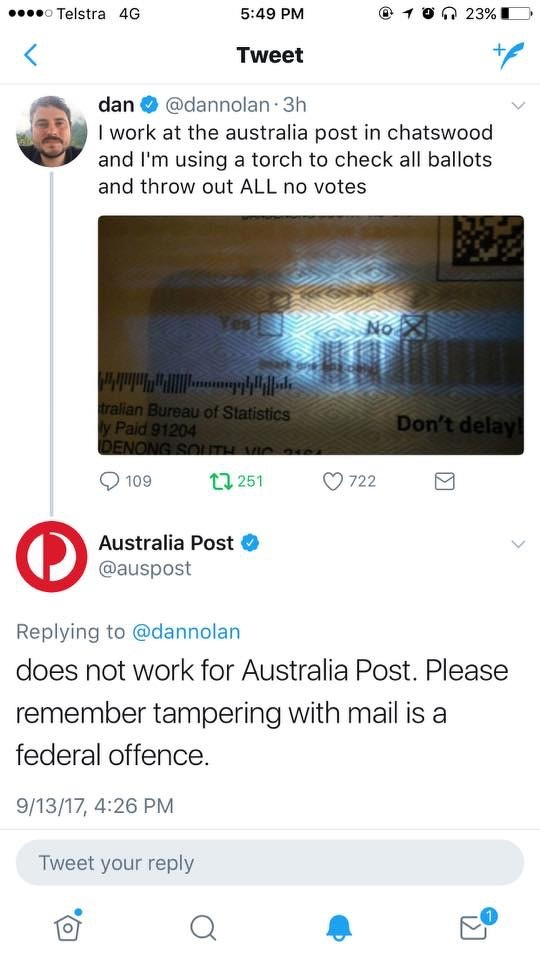
This sounds like something to know in advance. At 2pm AEST next Monday 27 July Australia’s new national warning system will send a test alert to phones and some tablets and smart watches. They’ll vibrate and emit a siren-like sound for about 10 seconds.
”Drawing on a critical meta-synthesis of cross-disciplinary literature, supported by ChatGPT-4o DeepResearch, the paper develops a reflexively grounded research guide for navigating methodological practice in an increasingly complex research landscape shaped by geopolitical contestation and renewed demands for equity and inclusion”
A “reflexively grounded research guide” based on whose reflexivity exactly?
People routinely misunderstand Judge Dredd but this is an all-time standout: a LinkedIn post saying the lesson we need to learn from it is about human-in-the-loop AI use.
That torment nexus tweet wasn’t satire at all.
When this masthead visited Merrylands on Thursday to talk to locals about their experience of organised crime, no one approached was willing to share their story.
lmao
This is bleak, even for the Torment Nexus.
We shouldn’t over-sentimentalise reading as a practice, however I now get student feedback complaints when I set 4 page HBR magazine-style articles as course readings.
Let’s make sure the labelling debacle is the last time a health harming industry is allowed to set the conditions of their own regulation.
“Joe Lim estimates that 90 percent of what you see on the internet is advertising in disguise, and he should know”
Budget for a broken social contract
Greg Jericho on last night’s budget, and the kicking it gives to people with disabilities:
And so now we have a government saying those with disabilities need to be kicked off the NDIS because gas companies need their profits…
Most people know someone on the NDIS, and few would think they are rorting it. The problem, of course, is that the NDIS is a Productivity Commission idea, which believes the private sector delivers better efficiency than the public sector.
It never does. It always leads to profiteering and worse service and yet when you are beholden to neo-liberalism, what need have you for reality?…
Because people know with such things what happens is the shonks rort the system and get away with it, while those with disabilities need to endure the cuts because ‘spending is out of control’.
Hard to walk back the impact of this paper though…
Influential study touting ChatGPT in education retracted over red flags
An important argument, powerfully put by Erin Longbottom. We have an obligation to do better, sectorally and personally.
More on the Job Ready Graduates Program, a failed, deeply inequitable policy that needs immediate reform:
“The [2025] modelling… shows the number of students with debts over $50,000 has increased by 70%, and humanities students are set to pay off their debts into their 40s.”
When considering what’s the purpose of Anzac Day, we should pay as much attention to what people do as to what they say:
“…a number of crowd members booed loudly and repeatedly during an Acknowledgment of Country by Uncle Ray Minniecon…
“We have experienced this type of racism for over 200 years,” he told media after the service. “One of the questions that we have in our minds is: What crime did we commit to attract this kind of racism?””
Loud boos mar Anzac Day dawn services in Martin Place and Melbourne - SMH
I thought you’re not supposed to go to war with your own client states (he says nervously)
Could Trump withdraw US support for UK sovereignty of Falklands? - The Guardian
“…we have a choice about who we want to be as a society. For me, that choice is clear. I want to live in a country where people seeking safety are not treated as risks to be managed, but as people to be protected. Because safety should not come with conditions. And belonging should not depend on how we are described.”
Angus Taylor’s comments remind refugees like me that our belonging is conditional - Thouraya Lahmadi
In March, research published in the international science journal Nature found that ocean levels had been underestimated due to inaccurate modelling. In some areas of the global south, including south-east Asia and the Indo-Pacific, they may be 100cm to 150cm higher than previously thought.